
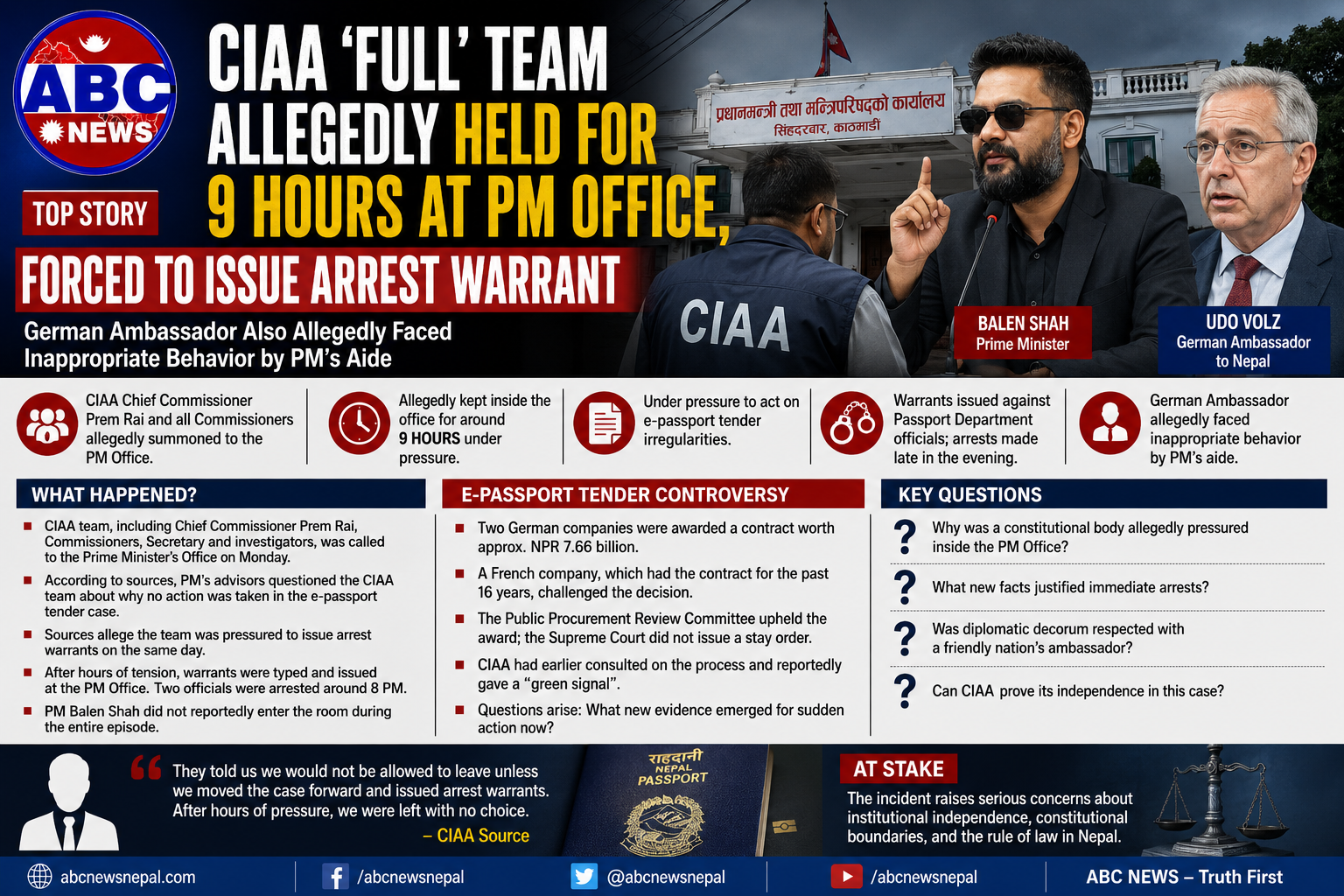
Kathmandu, June 18 — A series of extraordinary allegations involving Nepal’s Prime Minister’s Office (PMO), the Commission for the Investigation of Abuse of Authority (CIAA), and diplomatic representatives of Germany has triggered intense debate about constitutional boundaries, institutional independence, and the ongoing investigation into Nepal’s multi-billion-rupee e-passport procurement project.
If the allegations prove accurate, legal experts say the episode could represent one of the most controversial confrontations between a constitutional watchdog and the executive branch in recent years.
The Alleged Nine-Hour Standoff
According to multiple government and anti-corruption sources cited by local media, senior officials of the CIAA—including Chief Commissioner Prem Rai and fellow commissioners—were summoned to the Prime Minister’s Office earlier this week amid growing scrutiny over the procurement of Nepal’s next-generation electronic passports.
Sources claim that CIAA officials, senior Foreign Ministry representatives, and passport department officials remained at the Prime Minister’s Office for several hours while discussions focused on why no immediate action had been taken regarding alleged irregularities in the passport tender.
The report alleges that members of the Prime Minister’s advisory team pressed anti-corruption officials to move forward with arrests and formal investigations on the same day.
By evening, arrest warrants were reportedly issued against senior officials of the Department of Passports, and arrests followed shortly afterward.
No official public statement has been released confirming that CIAA officials were pressured or prevented from leaving the premises. Nevertheless, the allegations have sparked widespread concern among constitutional experts and former bureaucrats.
Why the Allegations Matter
The CIAA is not an ordinary government agency.
Established under Nepal’s Constitution, it functions as an independent constitutional body tasked with investigating corruption and abuse of authority across government institutions—including the Prime Minister’s Office itself.
This separation exists to ensure checks and balances within the democratic system.
Constitutional scholars argue that any direct attempt by executive officials to influence investigative decisions would raise serious questions about the independence of anti-corruption institutions.
“The credibility of an anti-corruption commission depends on its ability to act independently and without political direction,” one former constitutional official said.
The central question emerging from the controversy is not merely whether corruption occurred in the passport procurement process, but whether constitutional boundaries between the government and the watchdog tasked with investigating it were respected.
The German Diplomatic Angle
Adding an international dimension to the controversy are reports involving Germany’s ambassador to Nepal, Udo Volz.
According to sources familiar with the matter, the ambassador sought meetings with Prime Ministerial representatives after two German companies emerged as winners of Nepal’s e-passport procurement tender.
The ambassador reportedly attempted to explain the procurement process and defend the reputation of the companies involved, one of which is partly owned by the German state.
Reports allege that interactions between diplomatic representatives and officials at the Prime Minister’s Office became unusually tense, with accusations of inappropriate conduct toward the ambassador.
Neither the German Embassy nor Nepal’s government has publicly detailed the content of those discussions.
However, diplomatic observers note that disputes involving foreign state-linked companies often carry broader implications for bilateral relations.
Understanding the E-Passport Tender
The controversy centers on a major government procurement project involving the supply and management of approximately 6.4 million electronic passports over a five-year period.
Following an international bidding process, two German firms were selected to provide different components of the system.
One company was awarded responsibility for biometric data systems and infrastructure, while another secured the contract for passport booklet production and personalization services.
Government officials involved in the process argue that the procurement underwent multiple layers of scrutiny, including technical evaluations, legal reviews, procurement oversight, and consultations with relevant state agencies.
Sources familiar with the tender maintain that the process was reviewed repeatedly and survived legal challenges from competing bidders.
The French Connection
The dispute did not emerge in a vacuum.
For nearly two decades, a French multinational company had been involved in supplying Nepal’s passport infrastructure.
After losing the latest tender competition, the French firm challenged the outcome through Nepal’s procurement review mechanisms and later sought judicial intervention.
According to officials familiar with the case, both the procurement review committee and subsequent court proceedings allowed the German companies to proceed with implementation.
Critics of the current investigation therefore ask an obvious question:
If procurement review bodies, technical evaluators, and courts found no immediate grounds to halt the contract, what new evidence prompted such urgent intervention?
Government officials involved in the investigation have yet to publicly explain the precise basis for the recent actions.
Two Competing Narratives
The controversy now appears to be driven by two competing interpretations.
Supporters of the investigation argue that corruption cases often involve sophisticated schemes that may not be immediately visible during routine procurement reviews. They contend that investigators have a responsibility to pursue credible allegations regardless of political sensitivity.
Critics, however, question both the timing and the manner of the intervention.
They argue that if investigators were genuinely convinced wrongdoing occurred, the process should have unfolded through normal institutional channels rather than amid allegations of direct executive pressure.
The debate therefore extends beyond the passport contract itself.
It has become a debate about how state institutions interact with one another.
Questions Facing the CIAA
The controversy has also placed the anti-corruption commission under unprecedented scrutiny.
If CIAA officials already possessed sufficient evidence to justify arrests, critics ask why action had not been taken earlier.
Conversely, if they did not believe arrests were warranted, why did they allegedly proceed after meetings at the Prime Minister’s Office?
These questions go directly to the heart of institutional credibility.
The CIAA’s independence has long been regarded as a cornerstone of Nepal’s constitutional architecture. Any perception that its decisions can be influenced by political actors could damage public confidence in future investigations.
A Test for Nepal’s Institutions
Ultimately, the e-passport controversy has evolved into something larger than a procurement dispute.
It is becoming a test of Nepal’s constitutional system itself.
The public now awaits answers to several critical questions:
- Did executive officials improperly pressure a constitutional watchdog?
- What evidence justified the arrests?
- Were diplomatic norms respected during interactions with foreign representatives?
- Can the CIAA demonstrate that its decisions were made independently and according to law?
The answers may determine not only the future of the e-passport investigation, but also public trust in Nepal’s democratic institutions.
Until then, what began as a procurement dispute has become a broader national conversation about power, accountability, and the limits of executive influence in a constitutional democracy.



प्रतिक्रिया दिनुहोस्