


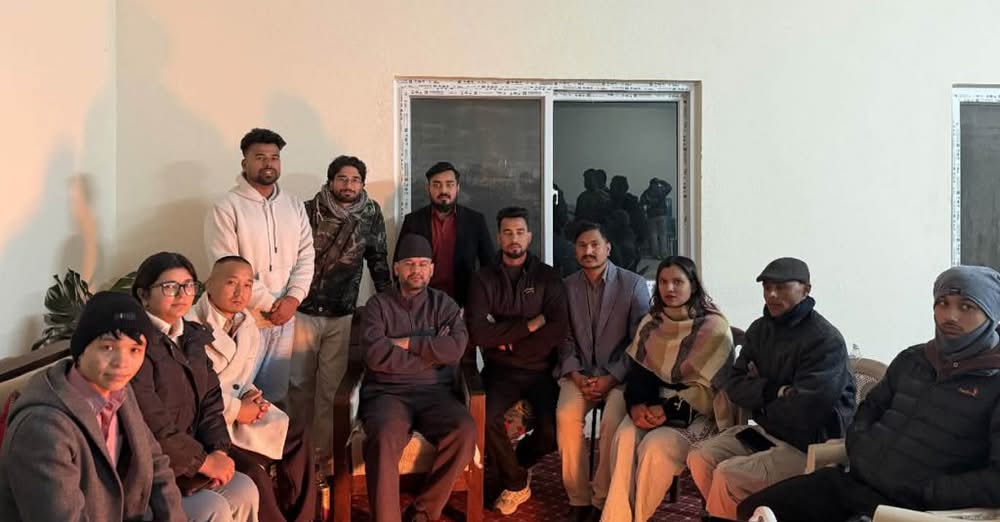
The Mysterious Strategic Dimension Behind the Curtain Silence and Gramsci
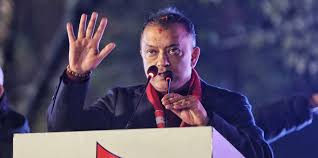
Shubha Shankar Kandel: From the far-eastern Jhapa to the flatlands of Sudurpashchim and the mountainous districts, the so-called “silent election campaign” run by senior Rastriya Swatantra Party (RSP) leader Balendra Shah (Balen) is not merely a stylistic experiment in Nepali politics—it is rapidly becoming a political style that provokes deep theoretical debate about power, legitimacy, and representation. Understanding this campaign merely as a tactic of complying with the election code of conduct or avoiding speeches is insufficient. It has illuminated new forms of contemporary political communication, symbolic power, and the construction of hegemony.
‘I’m heading from Baitadi to Bajura! May Goddess Badimalika bless everyone.‘
Silence and Gramsci: Alternative Construction of Hegemony
According to Italian Marxist thinker Antonio Gramsci, power is not established solely through force, but also through the construction of consent. Traditional election speeches, slogans, and manifestos constitute the “formal language of hegemony,” turning people into active listeners and spectators but rarely into genuine participants. Balendra’s silent campaign can be seen as rejecting this linguistic hegemony and attempting to build a new kind of consent with voters who are experiencing a “crisis of representation”—even if he may never have heard Gramsci’s name.
His silent presence—ringing the ‘bell’, visiting offices, tasting local food, sharing photos on social media—all these symbolic acts are a new experiment in conveying the message: “We are just like you.”
‘Even if rung slowly, the bell has to be rung, right? #Balenshah’
However, it is possible that his campaign strategists adopted this style due to a lack of oratory skills or deep understanding of Nepali society. In Gramscian terms, this is a counter-hegemonic practice, where dominance is attempted through cultural signs rather than traditional political expression.
Symbolic Capital
French sociologist Pierre Bourdieu considers the concept of “symbolic capital” crucial for understanding politics. The reason Balen can exert influence even while remaining silent is not his speeches, but the symbolic capital he has already accumulated: the image he built as Mayor of Kathmandu Metropolitan City, his “anti-corruption” identity, and the confrontational style he has maintained toward the established political class through anti-social-media behavior.
In his tours of the eastern region or far-western Nepal, he did not speak, yet he successfully created an environment that made it seem as if he had. Supporters, social media, photos, and status updates did the work of his appeal. According to Bourdieu, in such situations the individual himself becomes a “political text”—where presence alone is the message. How effective this will prove remains to be seen. Time will have the final say.
Post-Verbal Campaign
In modern political communication theory, this is called a “post-verbal” or “low-speech campaign.” In Western contexts, one can draw parallels with Barack Obama’s symbolic rallies, Donald Trump’s performative silence on certain occasions, and Narendra Modi’s ‘ritualized appearances’ in India. However, those leaders had clear political ideologies, well-defined paths and programs after coming to power—even if those plans and agendas were seriously debated and remain controversial. In contrast, Balen’s team has not yet made public any concrete program, defined agenda, or conceptual framework. This carries the risk of becoming an even more ambiguous and geopolitically tactical tool.
Balen’s silence is not merely an absence of speech; it can also be considered a transformation of communication, where visuals, feelings, and digital reproduction (digital amplification) become more effective than direct speech. During the far-western tour, status updates written in Doteli, photos of local surroundings, and the buzz that “the leader came but didn’t speak” have themselves become the communication.
Silence and Post-Populism Politics
Theoretically, this campaign can also be understood as an early sign of post-populist politics. Populism is usually based on “loud voices,” “sharp and shrill language,” and “enemy construction.” But Balen’s silence does not name enemies or raise slogans—instead, it seeks to reflect and consolidate dissatisfied public sentiment within that very silence. The problem, however, is that even those who gather around his group or the election symbol often do not know why they are there themselves. Social media trolls, inflammatory content, and hate-filled status updates continue to fan these flames.
This silence leaves an empty space for voters, allowing them to project their own expectations, anger, and hopes onto the leader. In political psychology, this is called projective identification.
Limitations
Nevertheless, a silent campaign is not always successful. As Gramsci warned, if consent is not institutionalized over the long term, hegemony cannot endure. If silence is not transformed into long-term policy clarity, it will remain confined to “image politics” at best—and could even turn disastrous. In Bourdieu’s interpretation, symbolic capital also erodes if it is not sustained by institutional achievements and policy outcomes.
From the day of filing his candidacy until now, Balen’s silent election campaign displayed from east to far-west is a novel experiment in Nepali politics—one where signs appear more powerful than words, presence more effective than speeches, and feeling more potent than declarations. Beyond being merely a strategy to win elections, this campaign seems to be a political experiment that compels a rethinking of representation, communication, and hegemony. What Balen is doing now may be somewhat more than what he and his domestic strategists had planned—a realization that competing political parties, leaders, and even the founders of the bell party itself need to understand. This is the first such style experiment in Nepali politics; the final answer to its success will be given by the election results. But theoretically, this silence has already been recorded as a moment that exerts a deeper impact than voice in Nepali politics.
#BalenShah #Populism #PostPopulism #ElectionUpdate


प्रतिक्रिया दिनुहोस्