

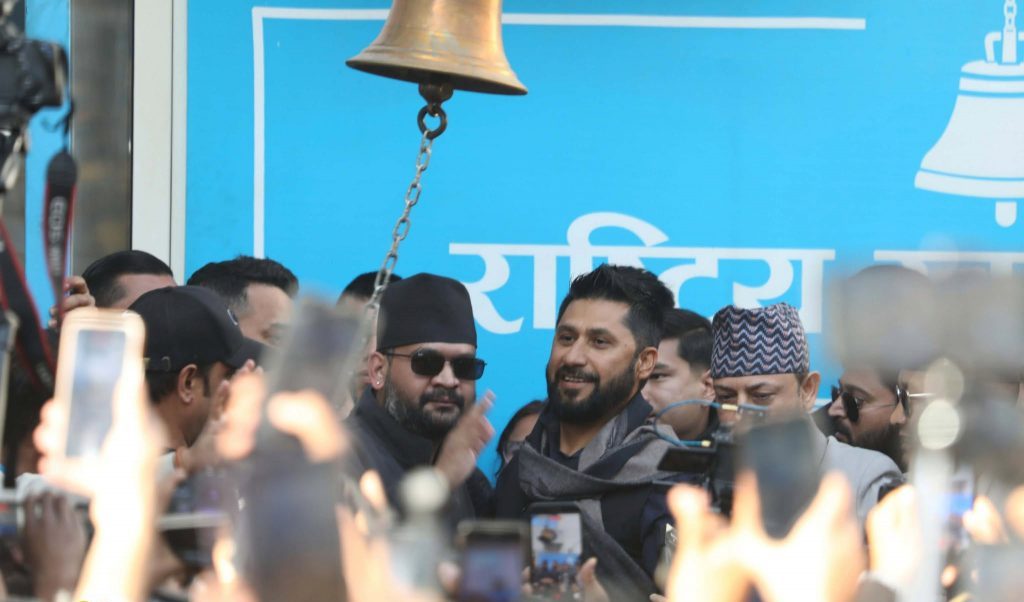
Kathmandu, Feb. 11(ABC Commentry) : The Rastriya Swatantra Party (RSP) has launched an aggressive campaign for the February 21 by-election by projecting Balen Shah as its future prime minister. After securing 1.13 million proportional votes and 21 parliamentary seats in the 2022 general election—despite being newly formed—the party has now set an ambitious target of winning 151 seats.
However, political analysts argue that the party’s rise is not grounded in ideological clarity or programmatic depth, but rather in a wave of pure populism.
Filling a Political Vacuum
In the aftermath of what was described as the “Gen Z rebellion,” a political vacuum emerged. RSP appears to have capitalized on public frustration by making an emotional appeal—“Give us one chance”—and channeling voter disillusionment toward itself.
After completing campaign tours across eastern and western Nepal, Balen is now actively campaigning in Madhesh Province. Following legal cases against party founder Rabi Lamichhane—including cooperative fraud, organized crime and money laundering charges—the party repositioned Balen as its prime ministerial face. On December 28 (Poush 13), RSP formalized this strategy through a seven-point agreement with the Balen group.
The Making of a Populist Icon
Balen Shah rose to prominence after winning the 2022 Kathmandu mayoral election as an independent candidate. At just 32 years old, he defeated Nepali Congress candidate Srijana Shrestha(Singh) and UML’s Keshav Sthapit by a margin of 23,426 votes—an extraordinary victory in what had long been a stronghold of the two major parties.
His decisive win dramatically boosted his popularity. Though he appeared less frequently in formal public debates after becoming mayor, he consistently used social media to criticize the federal government and traditional political parties, positioning himself as a voice of frustrated youth. Over three years, his image grew so dominant that a narrative emerged suggesting, “There is no alternative but Balen.”
Rabi Lamichhane similarly rode the populist wave. With no prior political background, he quickly transformed RSP into the fourth-largest force in Parliament and became Deputy Prime Minister and Home Minister. However, after the Supreme Court ruled against him in a dual citizenship case, he lost his position within 42 days. Following his by-election victory in Chitwan-2 in April 2023, Lamichhane reinforced his populist narrative by accusing the state of political retaliation.
Strategic Expansion
RSP has fielded candidates in 110 proportional and 165 first-past-the-post constituencies, largely nominating celebrities and so-called popular figures. It embraced the Gen Z movement and absorbed youth groups and the Bibeksheel Sajha Party. Although it reached a seven-point agreement with the faction aligned with former Energy Minister Kulman Ghising, that alliance collapsed over power-sharing disagreements.
Why Is Populism Dominating?
Political analyst and Editor-In-Chief of ABC Media Group Shubha Shankar Kandel traces the current trend back to the 2006 People’s Movement. After the Constituent Assembly elections, debate intensified over whether the era of traditional parties had ended and whether their agendas had become obsolete.
“Nepal has changed under the influence of old ideas,” Kandel writes on Kantipur Daily. “Political goals have shifted. When traditional parties failed to reorganize themselves, discussions about alternative politics gained momentum.”
New political forces such as Naya Shakti and Bibeksheel Sajha emerged but failed to meet public expectations. Meanwhile, corruption, poor governance and entrenched leadership structures deepened public frustration.
“People grew disillusioned. They felt the old forces were no longer effective,” Kandel explains.
Into this vacuum stepped the RSP, presenting itself as a vehicle for change. “Voters approved RSP not necessarily because of its ideology, but because they wanted to give someone else a chance,” he adds.
Mr Kandel writes in different commentary Balen’s rise as a “phenomenon” that RSP successfully capitalized on.
“Balen emerged as a phenomenon, and RSP brought him into its fold,” he says. “But how much influence and power he will ultimately wield remains to be seen.”
According to Kandel Nepal is witnessing the rise of political “consumerism” alongside populism. Voters increasingly treat political figures like products.
“Balen is popular; voters want Balen. On that basis, RSP onboarded him. If this consumerist dynamic continues to be fed, it could eventually create terrain for a majority,” he argues.
Is RSP Truly an Alternative?
Kandel outlines five reasons why he does not consider RSP a genuine alternative party:
- Ideological Innovation: A true alternative must introduce new ideas beyond liberal democracy or traditional socialism. RSP has not demonstrated such ideological originality.
- Clear Agenda for Today’s Crises: How will it address poverty, corruption, development and national dignity? What distinguishes its solutions from those of older parties? Its agenda remains vague.
- Internal Democracy: An alternative party should model stronger internal democracy than traditional parties. RSP’s transparency and internal openness are questionable.
- Leadership Formation: How were Rabi appointed as chair and Balen as senior leader? Where is grassroots endorsement? Member participation in decision-making appears limited.
- Political Culture: Has the party broken from old leadership styles and bridged the gap between leaders and citizens? Critics argue it replicates traditional patterns.
“Measured against these five criteria, RSP is not truly alternative,” Political scientist Dr Lokraj Baral Tradces with ABC Television. “It amplifies emotional discontent, creates waves of excitement, but struggles to sustain serious policy discourse. An agenda-less politics could push the country toward another crisis. Like junk food, it may cause long-term damage.”
What Lies Ahead?
Whether RSP’s populist surge translates into decisive electoral gains in the February 21 by-election remains to be seen. But the broader debate is intensifying: What are the long-term consequences of agenda-free populism for political stability and development?
If public frustration continues to be channeled through personalities rather than programs, Nepal’s political transformation may prove volatile rather than sustainable.
The rise of the so-called “alternative” force has energized the electorate—but whether it represents renewal or merely another cycle of populist disruption remains an open question.

प्रतिक्रिया दिनुहोस्