


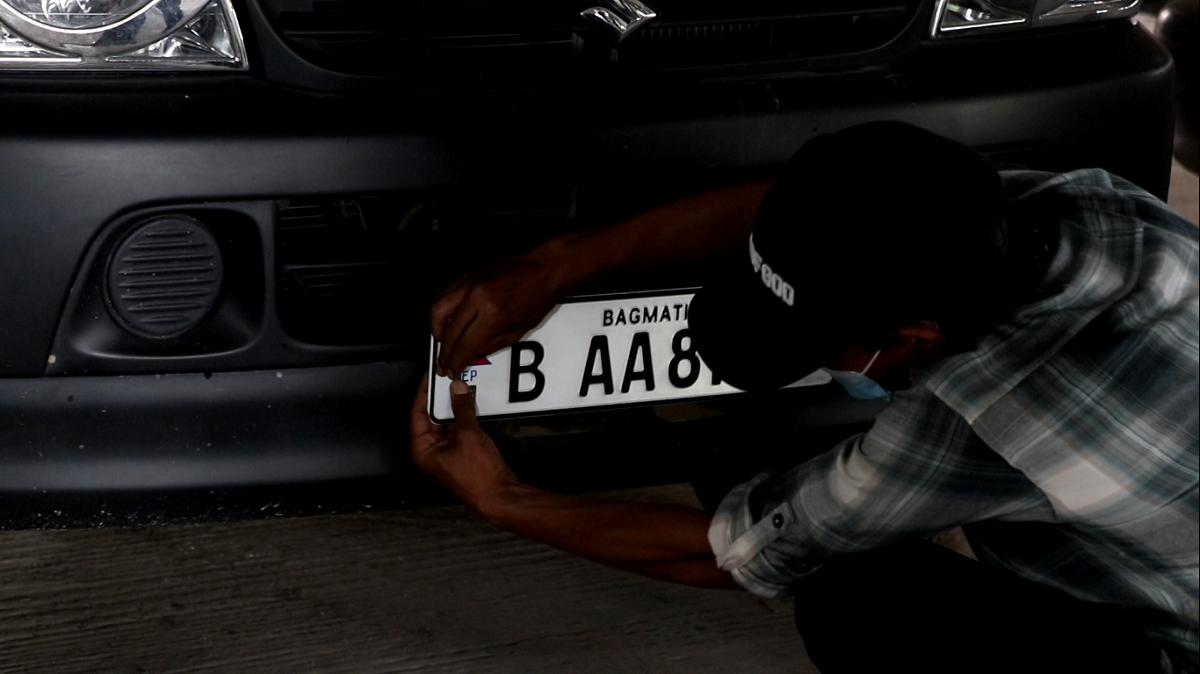
Kathmandu, Feb.10: The Supreme Court has issued an interim order directing the government not to implement the decision to use English language on embossed number plates for vehicles.
A joint bench of Justices Kumar Regmi and Mahesh Sharma Poudel issued the interim order on Sunday, halting the implementation of the decision to introduce embossed number plates in English.
“The implementation of embossed number plates in English language, as per the notice issued by the Department of Transport Management on Bhadra 3, shall not be carried out or caused to be carried out in light of the relevant constitutional and legal provisions,” the Supreme Court order states.
Background of the Decision
On Shrawan 20 last year, the thematic committee meeting chaired by the Minister for Physical Infrastructure and Transport decided to make embossed number plates mandatory for all vehicles. Following this, the Department of Transport Management issued a notice on Bhadra 3 announcing that embossed number plates would be prepared in English.
The decision sparked widespread controversy and legal challenge. On Poush 16, advocate Rambahadur Raut along with other lawyers filed a writ petition in the Supreme Court against the use of English on embossed plates.
On Poush 17, a single bench of Justice Nityananda Pandey had issued a show-cause order against the respondents. On Sunday, the joint bench went a step further and issued the interim order.
Constitutional and Legal Basis Cited by the Court
The Supreme Court relied heavily on the Constitution of Nepal in its reasoning:
- Article 32 guarantees the fundamental right to language and culture.
- Article 7(1) clearly states: “The Nepali language in Devanagari script shall be the language of official work in Nepal.”
- Article 7(3) provides that other matters relating to language shall be as decided by the government on the recommendation of the Language Commission.
- Article 1 declares that it is the duty of every person to observe the Constitution.
The court also referred to the earlier constitutional bench decision in the writ petition no. 2074-WO-0554, where — prior to the final verdict on Mangsir 27, 2076 — the Motor Vehicles and Transport Management Act had required letters and numbers on embossed plates to be in English script.
However, after that verdict, the Act was amended on Baisakh 14, 2080. The amended provision states that letters and numbers on embossed number plates shall be in Devanagari script, English script, or a combination of both, as decided by the Government of Nepal. This amendment was also published in the Nepal Gazette.
The Supreme Court emphasized that the amended law gives first priority to Devanagari script.
Language Commission’s Stance
The Language Commission had also, on Bhadra 1, 2082, decided and drew the government’s attention to use Devanagari script for electronic signaling numbers (embossed plates).
Despite this constitutional provision, the amended law, and the Language Commission’s recommendation, the Department of Transport Management issued a notice to prepare embossed plates in English — which the court found to be contrary to constitutional and legal provisions.
What Happens Next?
With the interim order in place, the government and the Department of Transport Management are restrained from proceeding with English-language embossed number plates until the final hearing and verdict on the writ petition.
The case has once again highlighted the long-standing debate over language use in official matters, especially the balance between Nepal’s constitutional commitment to Nepali in Devanagari script and practical considerations in modern vehicle registration systems.
The full hearing on the merits of the petition is awaited to determine whether the English-language embossed plates will be permanently halted or allowed in some form.



प्रतिक्रिया दिनुहोस्