


Roots of the Revolt: The “Gen-X Rebellion”
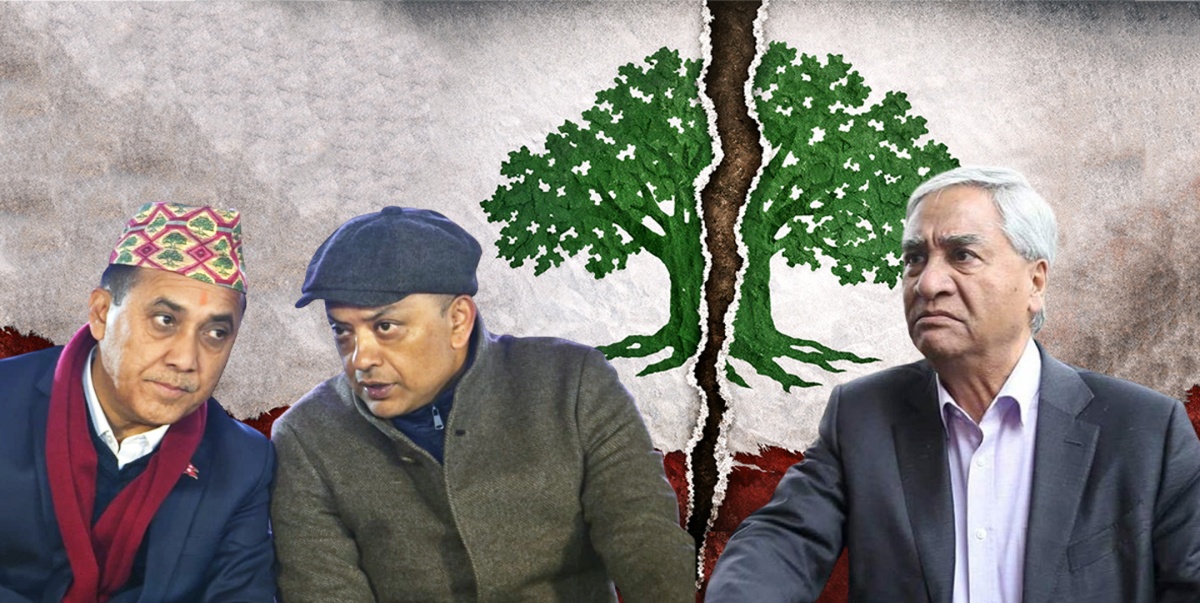
Kathmandu, Jan 14: Nepal’s oldest political party, the Nepali Congress, has formally split after prolonged internal conflict over leadership change and party reform failed to reach a compromise.
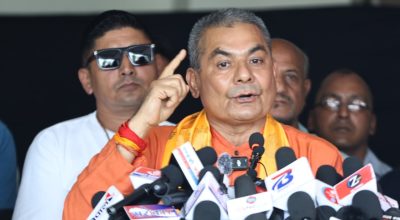
The split came after the party establishment led by Sher Bahadur Deuba took disciplinary action against General Secretaries Gagan Thapa and Bishwo Prakash Sharma, and Joint General Secretary Farmaullah Mansur, suspending them for five years on charges of violating party discipline.
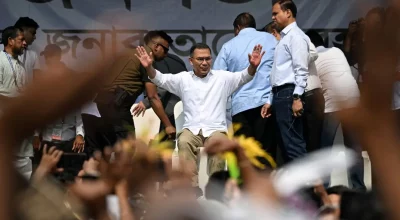
On the other side, leaders backing a Special General Convention have moved forward with a process to select Gagan Thapa as party president, effectively formalizing the division.
Reform vs Status Quo
For months, a majority faction within the party had demanded leadership change and organizational reform, arguing that the Nepali Congress could not contest upcoming elections under Deuba’s leadership. Despite repeated appeals, Deuba refused to step down, leading the internal struggle to escalate into an open split.
At the core of the conflict was a clash between those seeking transformation and those defending the status quo. The party’s Central Committee accused Thapa and other leaders of indiscipline, but Thapa responded by stating that the Nepali Congress “is not anyone’s private company.”
“This is a party built through struggle and sacrifice,” Thapa said, asserting his legitimacy within the party.
The Special Convention and Failed Talks
While the Deuba faction insisted that a special convention was not possible ahead of elections, the party’s reformist bloc pointed to the party statute, noting that 54 percent of convention delegates had formally demanded a special convention.
After the deadline to convene the convention expired on December 12, reformist leaders moved ahead regardless. Even as the special convention proceeded, multiple rounds of dialogue were attempted to prevent a split. Negotiation teams from both sides exchanged proposals, but neither faction was willing to compromise.
With Deuba refusing to relinquish the party presidency or endorse reform proposals, talks collapsed and the split became inevitable.
Roots of the Revolt: The “Gen-X Rebellion”
The current crisis has deeper roots in the September 23–24 Gen-Z protests, which forced then Prime Minister KP Sharma Oli and Congress President Deuba out of executive power. While Oli managed to reassert his leadership through a party convention, Deuba delayed similar reform within the Nepali Congress.
Instead, he handed day-to-day responsibilities to Acting President Purna Bahadur Khadka while retaining real control, pushing leadership change until after elections. This move intensified frustration among younger leaders—particularly those from the Generation-X cohort—who eventually mobilized for the special convention.
Structural Reforms and a New Political Direction
The four-day special convention passed sweeping reform proposals, many of them championed by Thapa and Sharma. These include:
- Mandatory leadership selection through primary elections
- Term limits: party president and prime minister limited to two terms, lawmakers to four terms
- Restricting proportional representation seats to one term per individual
- Ending faction-based advancement within the party
Supporters argue these reforms reflect changing societal expectations and address long-standing demands from younger voters, including transparency, accountability, and internal democracy.
A Generational Turning Point
In a symbolic moment, Bishwo Prakash Sharma publicly endorsed Gagan Thapa as a future party leader and potential prime minister, signaling a break from Nepal’s tradition of seniority-based leadership. The gesture was widely seen as a statement against political entitlement and a vote of confidence in younger leadership.
Not the First Split—but a Different One
The Nepali Congress has split twice before in its seven-decade history, often due to ideological or strategic disputes involving leaders such as BP Koirala, Ganesh Man Singh, Girija Prasad Koirala, and Sher Bahadur Deuba himself.
This time, however, the rupture is fundamentally generational—rooted not only in leadership rivalry, but in competing visions of political culture and democratic practice.
What Lies Ahead
The reformist bloc argues that this split is not merely about the future of one party, but about redefining Nepal’s democratic politics to align with the expectations of a new generation.
Whether the divided Nepali Congress can regain public trust—or whether this fracture reshapes Nepal’s political landscape permanently—remains to be seen.
Nepal’s Nepali Congress Split
Key Points:
- Nepal’s main opposition party, the Nepali Congress, has formally split after months of internal conflict over leadership change and party reform.
- The party establishment led by former prime minister Sher Bahadur Deuba suspended senior leaders Gagan Thapa, Bishwo Prakash Sharma, and Farmaullah Mansur for five years on disciplinary grounds.
- Reformist leaders moved ahead with a Special General Convention, initiating a process to select Gagan Thapa as party president.
- The split follows repeated demands by a majority faction that the party cannot contest elections under Deuba’s leadership.
- At least 54% of party convention delegates had formally called for a special convention under party statutes.
- Multiple rounds of talks failed after Deuba refused to step down or endorse structural reforms.
- The special convention passed sweeping reforms, including primary elections for leadership, term limits, and restrictions on repeated proportional-representation appointments.
- The crisis is rooted in broader generational tensions, with younger leaders calling for transparency, accountability, and internal democracy.
- Analysts say the split could significantly reshape Nepal’s opposition politics ahead of upcoming elections

प्रतिक्रिया दिनुहोस्