

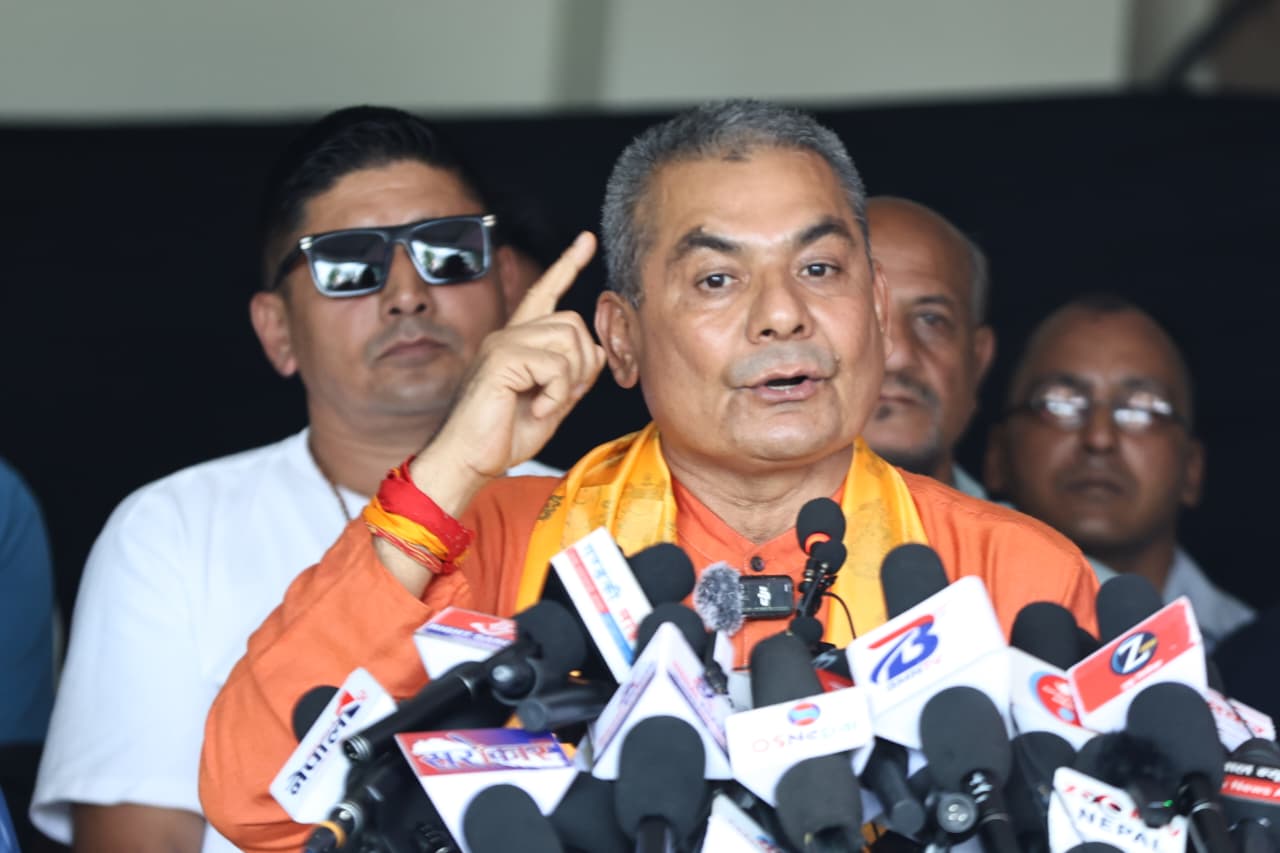
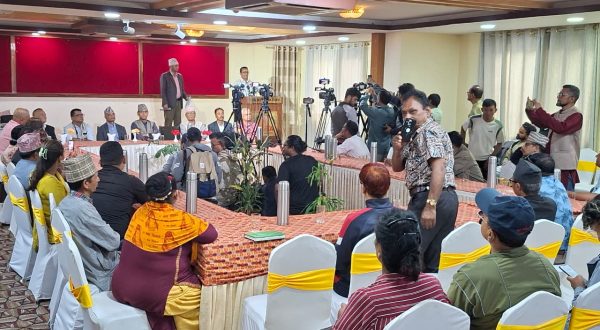
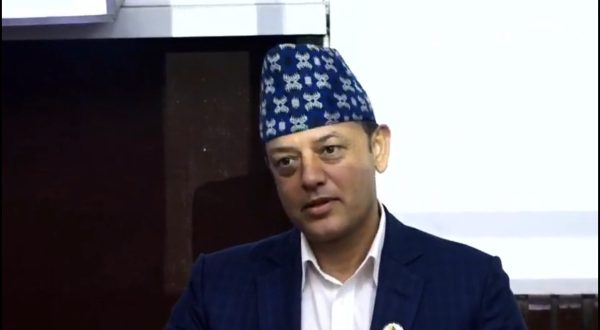
Kathmandu 12 Feb : Durga Prasai, a prominent Nepali medical businessman and the coordinator of the “Nation, Nationality, Religion, Culture, and Citizens’ Rescue Grand Campaign” (राष्ट्र, राष्ट्रियता, धर्म, संस्कृति र नागरिक बचाउ महाअभियान), made a series of explosive allegations during a press conference in Kathmandu on February 12, 2026 (corresponding to Magh 29, 2082 in the Nepali calendar).
Prasai is known for his pro-monarchy stance, advocacy for restoring Nepal as a Hindu kingdom, and criticism of the current republican system, which he views as a foreign-imposed structure. His campaign has often involved rallies, protests, and public challenges to the government, including calls to defy prohibitory orders. He has a history of legal troubles, including arrests related to financial disputes and incitement charges, but positions himself as a defender of Nepali sovereignty against alleged external interference.
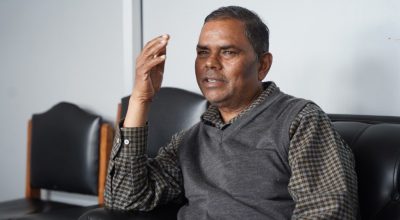
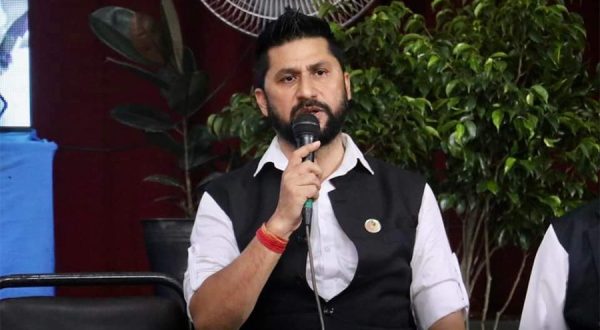
In this specific press conference, Prasai accused emerging political figures—particularly Kathmandu Metropolitan City Mayor Balen Shah, Rastriya Swatantra Party (RSP) President Rabi Lamichhane and Nepali Congress Newly elected President Gagan Thapa—of being agents of Western powers. He framed their rise as part of a “Deep State” conspiracy to destabilize Nepal, drawing a direct parallel to how Ukrainian President Volodymyr Zelensky was allegedly “groomed” and propelled into power. These claims echo broader conspiracy theories about foreign influence in Nepali politics, particularly amid ongoing tensions over federalism, secularism, and elections. Prasai’s rhetoric is unsubstantiated but resonates with pro-monarchy and nationalist groups who feel disenfranchised by the post-2006 political order.
Core Claim: Balen, Rabi, and Gagan as Western “Agents” Modeled After Zelensky
Prasai’s central accusation is that Balen Shah, Ravi Lamichhane, and Gagan Thapa are not organic leaders but “puppets” engineered by Western powers (primarily the U.S. and its allies) to erode Nepal’s national identity, monarchy, and Hindu status. He compares this to Zelensky’s rise in Ukraine:
- The Zelensky Parallel: Prasai alleged that just as Zelensky—a former comedian and actor—was transformed into a “hero” through social media manipulation and foreign backing, leading Ukraine into conflict with Russia, the same “model” is being applied in Nepal. He claimed Western forces used social media algorithms to amplify Balen and Ravi’s popularity, portraying them as anti-establishment saviors while secretly advancing a destabilizing agenda. In Ukraine, Prasai argued, this led to war and national ruin; in Nepal, it’s aimed at creating chaos to fragment the country, potentially turning it into a base against China (via “Free Tibet” agendas).
- Specific Accusations Against Individuals:
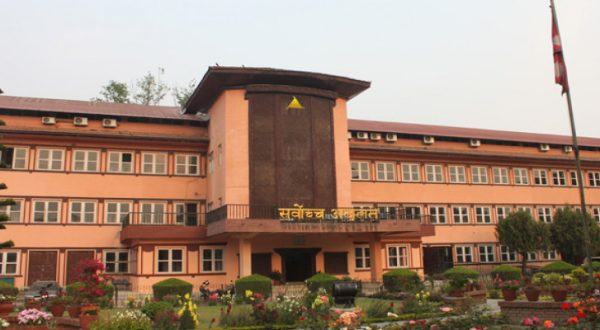
- Balen Shah (Ex-Mayor of Kathmandu): Prasai labeled Balen as the “test case” for this strategy. He claimed Balen was selected for his charisma and trained by organizations like the American Youth Council and British Council. Prasai accused Balen of manipulating social media to “capture algorithms” and mislead public opinion, funded by foreign sources. He linked Balen to recent events like the Gen-Z protests (which involved arson at Singha Durbar and the Supreme Court), calling them part of a Western plan. Prasai equated Balen’s behind-the-scenes planning to direct involvement in violence, demanding he be punished alongside street protesters.
- Ravi Lamichhane (RSP President): Similarly, Prasai alleged Ravi was “launched” after Balen’s success, using his media background (as a former TV Acnhor) to build a heroic image. He claimed Ravi’s rapid rise in politics, including forming the RSP and gaining parliamentary seats, was orchestrated to disrupt traditional parties. Prasai tied this to broader efforts to abolish the monarchy.
- Gagan Thapa (Nepali Congress Leader): Prasai grouped Gagan with the others as an “elite” figure complicit in the Deep State, accusing him of being a “lackey” who benefits from Western funding while pretending to be progressive.
These figures, according to Prasai, are part of a 13-year “master plan” starting from 2013-2014, involving events like Dr. Govinda KC’s hunger strikes and the emergence of parties like Bibeksheel Sajha. He claimed this plan aims to establish a “new Dalai Lama” in Nepal’s Himalayan regions, using the country as a proxy against China.
Supporting “Evidence” Presented by Prasai
During the conference, Prasai showed video clips and made references to bolster his narrative, though these were not independently verified:
- National Endowment for Democracy (NED) and Western Interference: He accused the U.S.-based NED of “naked intervention” in Nepal, funding NGOs and political actors to promote secularism, federalism, and republicanism. Prasai claimed this began before Nepal’s 1951 democracy restoration and intensified after King Mahendra’s death in 1972, viewing key historical events (e.g., 1990 People’s Movement, Maoist insurgency, 2015 Constitution) as steps to end the Hindu monarchy.
- Free Tibet Agenda: Prasai alleged Western investments since 2013 aim to use Nepal’s borders for anti-China activities, with new leaders like Balen and Ravi as tools to control Himalayan areas.
- Elite Complicity: He criticized Nepal’s “educated elite” for aiding this Deep State, including through social media manipulation and closed-door plotting.
- Gen-Z Movement and Violence: Prasai linked recent youth protests (including arson) to this conspiracy, accusing Balen and Ravi of indirect responsibility. He said, “Balen and Ravi, who plan in closed rooms, are as guilty as those who set fires on the streets and should be punished accordingly.”
Broader Context and Calls to Action
Prasai framed Nepal as on the brink of becoming “another Ukraine,” urging resistance:
- Restoration of Monarchy and Hindu State: He called the current system illegitimate, claiming 90% of Nepalis oppose elections, which he sees as a foreign ploy to seize power. Prasai invited leaders like KP Sharma Oli, Sher Bahadur Deuba, and Pushpa Kamal Dahal (Prachanda) to join if they accept a Hindu kingdom with monarchy. He accused communists of erring by attacking the king despite their nationalist leanings.
- Call for Protest: Prasai urged supporters to defy prohibitory orders and gather at Tribhuvan International Airport on February 13, 2026 (Falgun 1, 2082) to welcome former King Gyanendra Shah. He challenged authorities: “If you have the guts, handcuff the king. If anything happens, we’ll surround Nirmal Niwas and reinstall him in Narayanhiti Palace.” He expressed readiness for jail but not to witness national destruction.
- Economic Claims: Prasai boasted his campaign reduced bank interest rates from 16% to 6%, appealing to businesses and citizens to join.
These align with Prasai’s history of pro-monarchy activism, including clashes with authorities and alliances with nationalist groups.
Responses and Counterviews
Prasai’s claims have sparked debate in Nepali media and social circles, but direct responses from the accused are limited .
- Balen Shah: No explicit public response to these specific Zelensky comparisons was found. However, in broader contexts, Balen has faced similar accusations of foreign ties (e.g., from Prasai in October 2025, calling him a “Western pawn” in Gen-Z protests). Balen has focused on his mayoral duties, such as urban reforms, and positioned himself as an independent anti-corruption figure. Some online discussions (e.g., on Facebook) defend him as having a “clean image” and dismiss Prasai’s claims as diversionary, while others speculate on his foreign influences without evidence. In January 2026, Prasai challenged Balen to address Gen-Z demands before seeking higher office, but no reply is documented.
- Ravi Lamichhane: Similarly, no direct rebuttal to Prasai’s accusations appears in searches. Ravi has been embroiled in legal issues, including cooperative fraud probes and arrests (e.g., in December 2024 and April 2025), which he has framed as political persecution. He has emphasized his commitment to transparency and reform, stating in one instance, “I suffered punishment for mistakes I didn’t commit, now I’ll provide solutions.” His supporters view Prasai’s claims as smears from establishment figures.
- Gagan Thapa: Not directly addressed in searches, but as a mainstream Congress leader, he has historically advocated for progressive reforms, which Prasai opposes.
- Broader Stakeholder Views: Pro-monarchy groups echo Prasai, seeing Balen and Ravi as threats. Critics, including media outlets, label Prasai’s statements as inflammatory and potentially inciting violence, leading to his past arrests. Neutral observers note these claims fit Nepal’s polarized politics, with unsubstantiated foreign interference theories common amid Gen-Z unrest and election debates.
Implications
Prasai’s allegations reflect deep divisions in Nepali society: pro-monarchy nationalists vs. reformist youth and new parties. While his claims lack concrete proof and rely on conspiracy tropes, they tap into real concerns about foreign aid (e.g., NED grants to Nepali NGOs) and political instability. Balen and Ravi’s popularity stems from public frustration with corruption in traditional parties like Congress, UML, and Maoists—Balen through urban activism, Ravi via his anti-establishment party. The Zelensky comparison invokes fears of Nepal becoming a geopolitical pawn, especially given U.S.-China tensions over Tibet.
However, these remain Prasai’s opinions, often dismissed as rhetoric from a controversial figure with business interests (e.g., medical colleges, bank loans). If escalated, such claims could fuel protests or violence, especially around the king’s planned arrival. For balanced perspective, stakeholders like Balen and Ravi represent generational change, while Prasai embodies resistance to it. Monitoring official responses or further developments is advisable, as Nepal’s political landscape evolves rapidly.
प्रतिक्रिया दिनुहोस्